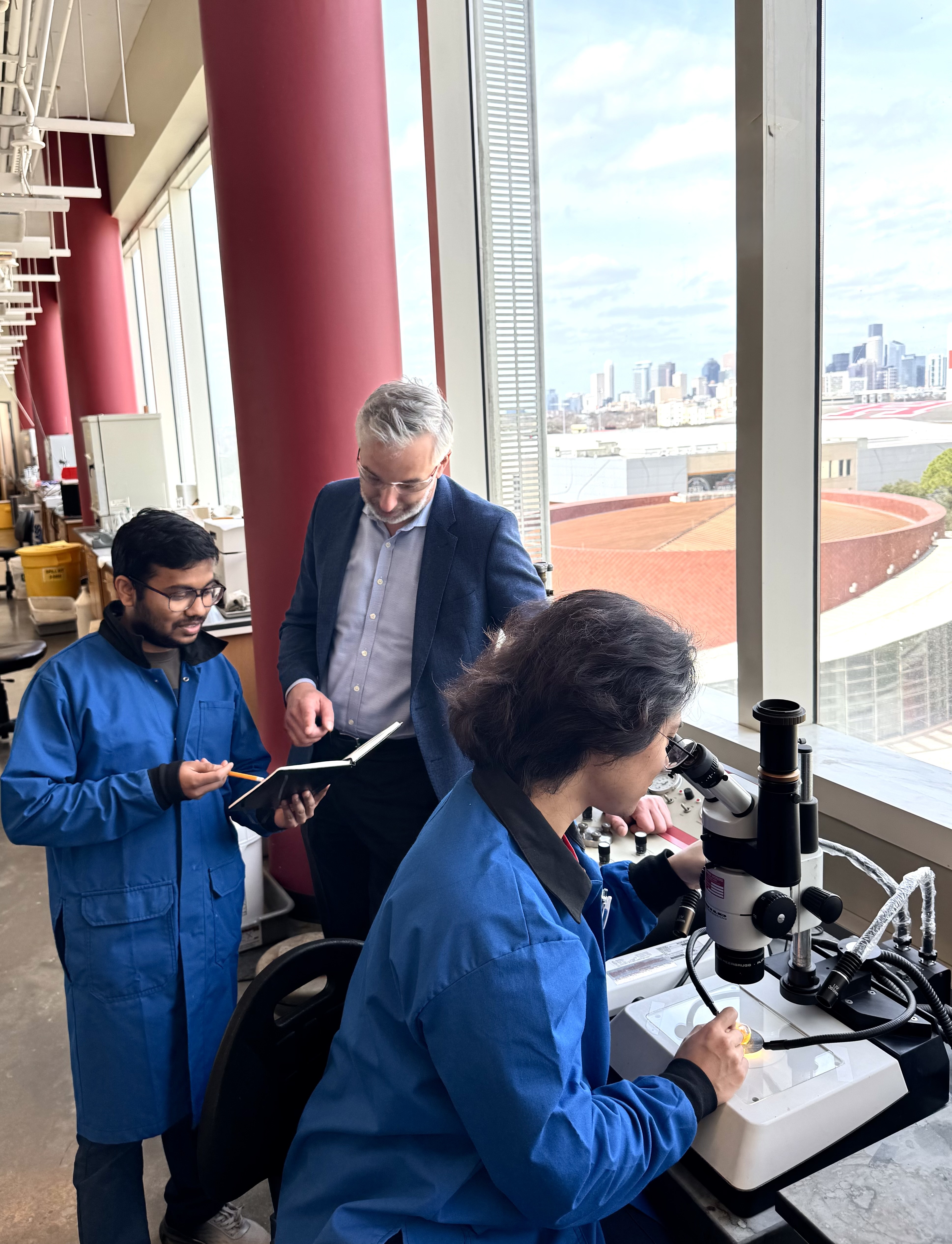
Connecting at the WelchX retreat, Ognjen Miljanić and Indrajit Srivastava are combining their very diverse research expertise to create a new category of imaging tools that could be a “game changer” for medical imaging.
In their individual work, Dr. Miljanić, Moores Professor of Chemistry at University of Houston, is leveraging supramolecular and synthetic chemistry to design unique, self-assembled molecular “cages.” Dr. Srivastava, an assistant professor at Texas Tech University, is an expert in bioimaging and nanoengineering who specializes in the development of novel polymer-based imaging probes.
In their WelchX research, they are combining their expertise to develop what they call a “ping pong imaging probe.” The goal is to create a brighter, more focused, and longer-lasting, self-sustaining light that ultimately could improve surgical outcomes.
Current fluorescent-based probes face two major challenges: they require constant external light excitation to remain visible, and this continuous illumination creates significant background “noise,” known as autofluorescence, as healthy tissues also reflect the light source, obscuring the target.
“He had these very cool molecules, and I brought the nanoengineering and bioimaging expertise needed to translate them into a biological environment,” Dr. Srivastava said.
“With Welch support, we are demonstrating proof of concept of a reversible reaction between singlet oxygen and molecular cages,” Dr. Miljanić said. “By stabilizing this process within a nanoengineered polymer-protein matrix, we will be creating an afterglow that could provide the sensitivity needed for deep-tissue applications.”
Dr. Srivastava is an expert in afterglow imaging, a technique that functions more like a battery than a mirror. Instead of reflecting light instantly, these probes soak up energy and “leak” it out slowly over time. This allows the target to glow in the dark long after the external light is turned off, providing a high-contrast map of the body with zero background interference.
The team is developing what they call a “ping-pong” probe, which combines two specialized components. Dr. Miljanić’s team has synthesized unique, cube-shaped molecular cages that act as a “trap” for oxygen molecules. When these cubes capture oxygen, they store light energy. As the oxygen “ping-pongs” inside the walls of the cube, it is continually reactivated, creating a sustained, steady glow.
Because these molecular cubes do not naturally dissolve in the body, Dr. Srivastava’s lab uses nanoengineering to wrap them in a protective “shell” made of specialized polymers and proteins (like bovine serum albumin). This process, known as nanoprecipitation, makes the probes safe and effective for medical use.
This protective shell does more than just transport the cubes; it amplifies them. Dr. Srivastava has previously demonstrated that this specific protein wrap can make an afterglow five times brighter. By applying this engineering to the new molecular cubes, the team aims to reach a benchmark Dr. Srivastava previously set: a glow that lasts for 20 minutes. This long-lasting "battery life" would give surgeons a clear, stable view during complex procedures.
While challenges lie ahead, such as identifying the best compounds to preserve the cube’s structure in water, the results to date have been very promising. The collaborators plan to investigate other geometries beyond the current cube to see how changing the internal space affects how fast they trap oxygen and how long the afterglow lasts.
“The true blessing of Welch support is funding studies for crazy ideas and enabling results from explorations based on real scientific curiosity,” Dr Miljanić said. “The WelchX program is a very welcome new way of looking at scientific collaboration in Texas. It is creating productive collaborations at completely unexpected intersections of research areas, and I am excited to see what will come of this.”
Dr. Srivastava agreed, “The two of us would never have connected in any other way: different disciplines, different institutions, difference stages in our careers. The WelchX program is a catalyst for combining my work in bioimaging with new molecular architectures to create exciting new science for Texas.”