When millions of monarch butterflies migrate seasonally across North America, they navigate with astonishing precision to the same sheltering sites each year. Kayla Goforth, a Welch Postdoctoral Fellow of the Life Sciences Research Foundation in the Merlin Lab at Texas A&M University, is helping unravel the mystery of butterfly navigation by probing one of biology’s most elusive senses: magnetoreception, the ability to detect Earth’s magnetic field.
While tagging sea turtles as an undergraduate, Dr. Goforth became fascinated by how the turtles returned repeatedly to very specific nesting sites to lay eggs. She pursued that curiosity during graduate school at the University of North Carolina at Chapel Hill, and her research there provided the first scientific evidence that two different mechanisms of magnetoreception underlie the magnetic map and compass senses in sea turtles.
“I fell in love with magnetic sensing,” Dr. Goforth said of her graduate work. “I wanted to study the genetics of it, and while we don’t yet have those tools for sea turtles, we definitely have those tools for monarchs. Christine Merlin’s lab is the only lab set up to do genetic ‘knockouts’ and establish mutant lines of monarchs that we can test with behavioral work, so I came to Texas to learn from Christine and to pursue that fundamental research.”
Dr. Goforth is building on the Merlin Lab discovery that a specific gene, CRY1, is necessary for the magnetic response in monarchs. Using CRISPR, she is employing a “knockout” approach to study the genetic mechanisms involved in the butterflies’ ability to use the magnetic field to migrate. She knocks out specific gene sequences and then evaluates whether the mutant butterflies can still detect changes in magnetic fields.
To evaluate the monarchs’ response to magnetic stimuli, Dr. Goforth developed behavioral assays in which the monarchs are gently tethered: they can flap their wings but remain stationary. When the magnetic field around them is altered, butterflies that can sense the change show a measurable burst of activity, whereas butterflies that cannot detect the field remain still. In addition to these behavioral assessments, she recently implemented electroretinography techniques. For these, she carefully immobilizes the butterflies and places microscopic electrodes directly on their eyes to measure their electrical responses to light and magnetic stimuli. By recording from specific regions of the eye, she hopes to pinpoint where magnetic sensing occurs at the cellular level.
“Many animals exploit Earth’s magnetic field as sensory stimuli for navigation, both as a compass to determine direction and as a map to determine geographic position,” she explained. “This is the last sense for which we don’t understand the mechanism, and the only one that doesn’t have an underlying sensor identified, such as how a nose is used for olfaction or eyes for vision.”
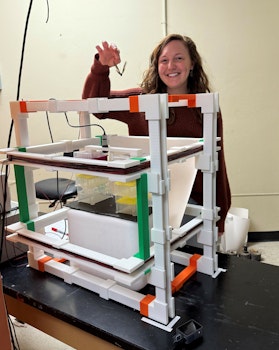
Her research requires a blend of biology, chemistry, engineering, and patience: Dr. Goforth designs the experiments and behavioral assays, breeds monarch mutants, maintains the health of the monarch colony, has designed and 3D-printed custom holders to stabilize the butterflies, and is building miniature magnetic coils to precisely test butterfly responses under a microscope. Her background prepared her well for this work: As a graduate student, she built behavioral assays from scratch and developed the patience and problem-solving skills directly transferable into establishing new model systems. Now, as a postdoctoral fellow, Dr. Goforth is independently driving research that will help her establish her own lab in the future.
“The Welch Postdoctoral Fellows Grant is great because it gives me the autonomy to explore my own ideas and define my own research direction. I can start working on what I want to in the lab and gain more research independence in preparation for my future career than if I had been hired to work on a project the lab already had funding for.”
Although Dr. Goforth’s research does not aim at immediate applications, it has far-reaching implications. Understanding how animals detect magnetic fields could inform the design of bio-inspired navigation systems. It may also shed light on how radiofrequency fields, such as those produced by phones, computers, and other technologies, might affect humans and animals, including monarch migration routes that pass through major urban corridors. Dr. Goforth’s primary goal is more about the joy of discovery.
“Fundamental science is really important because that’s where a lot of the groundbreaking discoveries are. For magnetic sensing, there’s so much we don’t know. We’re starting from the ground up and still trying to build a foundation. That makes it a really exciting field to be in. Doing the fundamental work is a lot of fun, and I’m grateful that The Welch Foundation supports it.”
Dr. Goforth and her research on butterflies, which is fully funded by The Welch Foundation and The Life Sciences Research Foundation, recently appeared in the New York Times article “In Pursuit of the Monarch’s Magnetic Sense.”